Actia AI Platform
The Actia AI platform is built on a multi-tenant SaaS architecture designed to provide high-fidelity AI agent interactions across multiple communication channels. At its core, the platform is structured into several distinct layers: the Interface Layer, the Orchestration Layer, the Intelligence Layer, and the Persistence Layer.
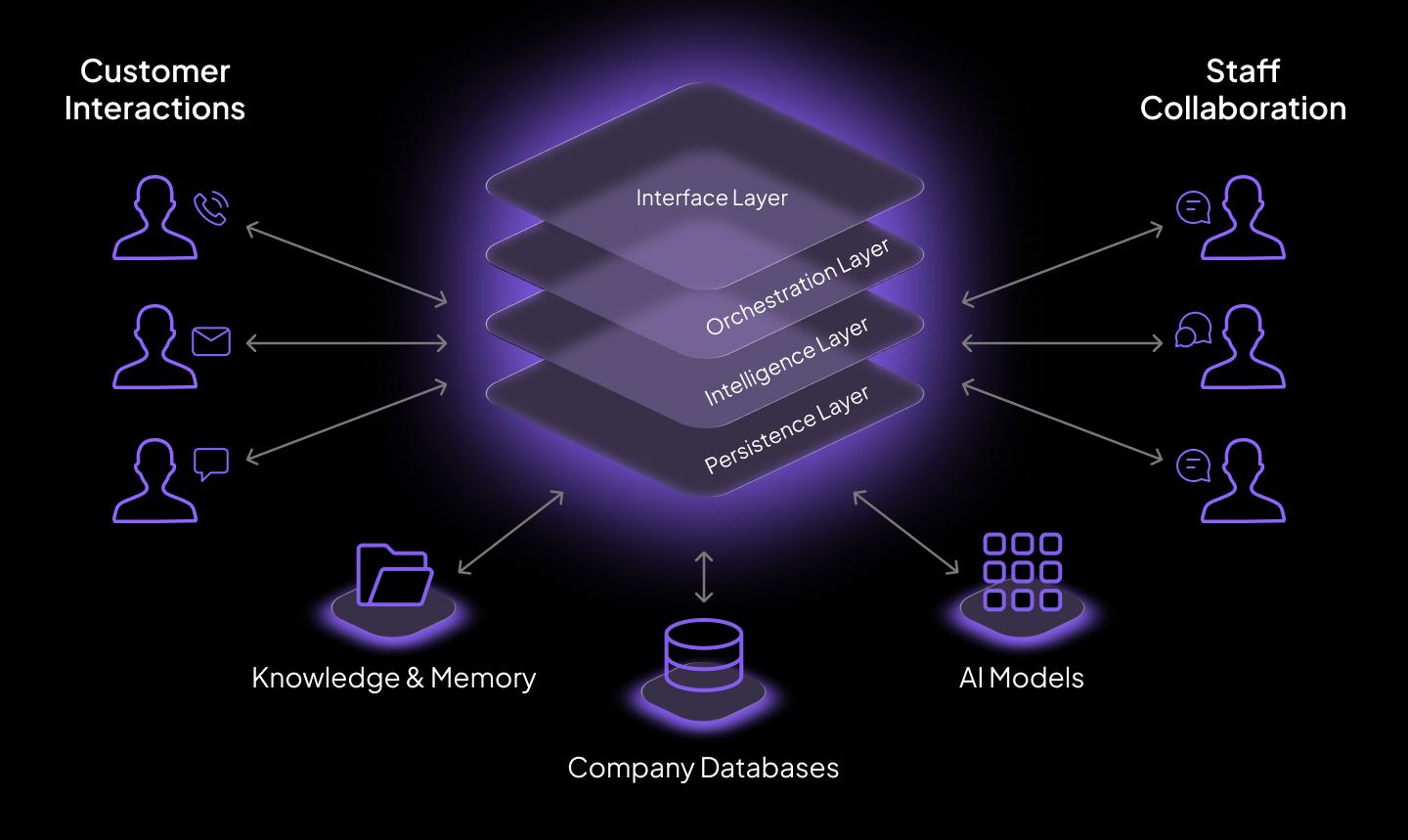
Interface Layer
The Interface Layer serves as the primary communication mechanism between the platform and the outside world. It handles incoming and outgoing traffic from channels including PSTN for voice, SMTP/IMAP for email, and WebSockets for real-time chat. For voice interactions, this layer manages the complex task of real-time audio streaming, utilizing low-latency protocols to ensure the transition between the user's speech and the agent's response feels natural. This involves tight integration with telephony providers and specialized hardware for signal processing.
Orchestration Layer
Moving inward, the Orchestration Layer acts as the conductor for all interaction. It is responsible for session management, state tracking, and ensuring that the agent adheres to its defined persona and organizational boundaries. When a message or audio stream enters the system, the Orchestration Layer determines the context, retrieves relevant history from the Persistence Layer, and prepares the payload for the Intelligence Layer. It also handles the guardrails — a set of deterministic rules that prevent the AI from making unauthorized commitments or stepping outside its professional role.
Intelligence Layer
The Intelligence Layer is where the actual language processing and token generation occur. This layer interfaces with multiple Large Language Models (LLMs) and specialized models for Speech-to-Text (STT) and Text-to-Speech (TTS). On an Actia platform, this isn't just a simple prompt-and-response mechanism. The system uses sophisticated retrieval-augmented generation (RAG) to inject specific knowledge-base information and durable agent memories into the model's context window. This ensures that when an agent responds to a question, the information is grounded in the customer's actual data rather than general training data.
Persistence Layer
The Persistence Layer provides the long-term memory for the entire system. This includes vector databases for efficient semantic search of knowledge bases and memory, multi-mode databases for structured data like contact records and configuration settings, plus specialized audit logs. Every interaction is recorded, not just for performance monitoring, but to allow the Orchestration Layer to maintain continuity across different sessions and channels. If a customer starts a conversation on chat and follows up via email, the Persistence Layer ensures the agent knows exactly where they left off.
Security & Multi-Tenancy
Security and multi-tenancy are woven throughout the entire platform stack. Each tenant's data, models, and configurations are strictly isolated to ensure there is no cross-pollination of information between different organizations. This is achieved through secure, multi-factor identity management and data encryption at rest and in transit. Every tenant runs their own siloed copy of the Actia platform engine, and each tenant's data resides in a logically isolated and replicated partition, ensuring data privacy and integrity at all times.
Built to Scale
By separating these layered functions, the Actia platform can scale horizontally to handle thousands of concurrent interactions, while maintaining the precision and personality required for high-stakes B2B communication. This architecture allows us to iterate on individual components — like upgrading a specific model in the Intelligence Layer — without disrupting the overall interaction flow or compromising the stability of the integration points.
For more on what the agents themselves can do, read about Actia agents.