Actia Agents
Actia agents are independent AI actors built to work seamlessly alongside company staff. They are configured with individual personas and follow established workflows to achieve defined outcomes. Agent personas can range from a warm receptionist to a precise technical specialist, with voice, tone, and knowledge aligned to the corporate brand they represent from the first moment of customer contact.
Omnichannel Communications
Actia agents operate across phone, email, chat, and messaging as a single persona rather than a separate bot per channel. Incoming messages and audio streams are normalized into a common representation before an agent reasons about them, and responses are rendered back into whichever channel the customer interaction is currently using. Because the channel is decoupled from the agent itself, conversations can move freely from phone to email to messaging while remaining, from the agent's perspective, one continuous exchange.
Roles & Personas
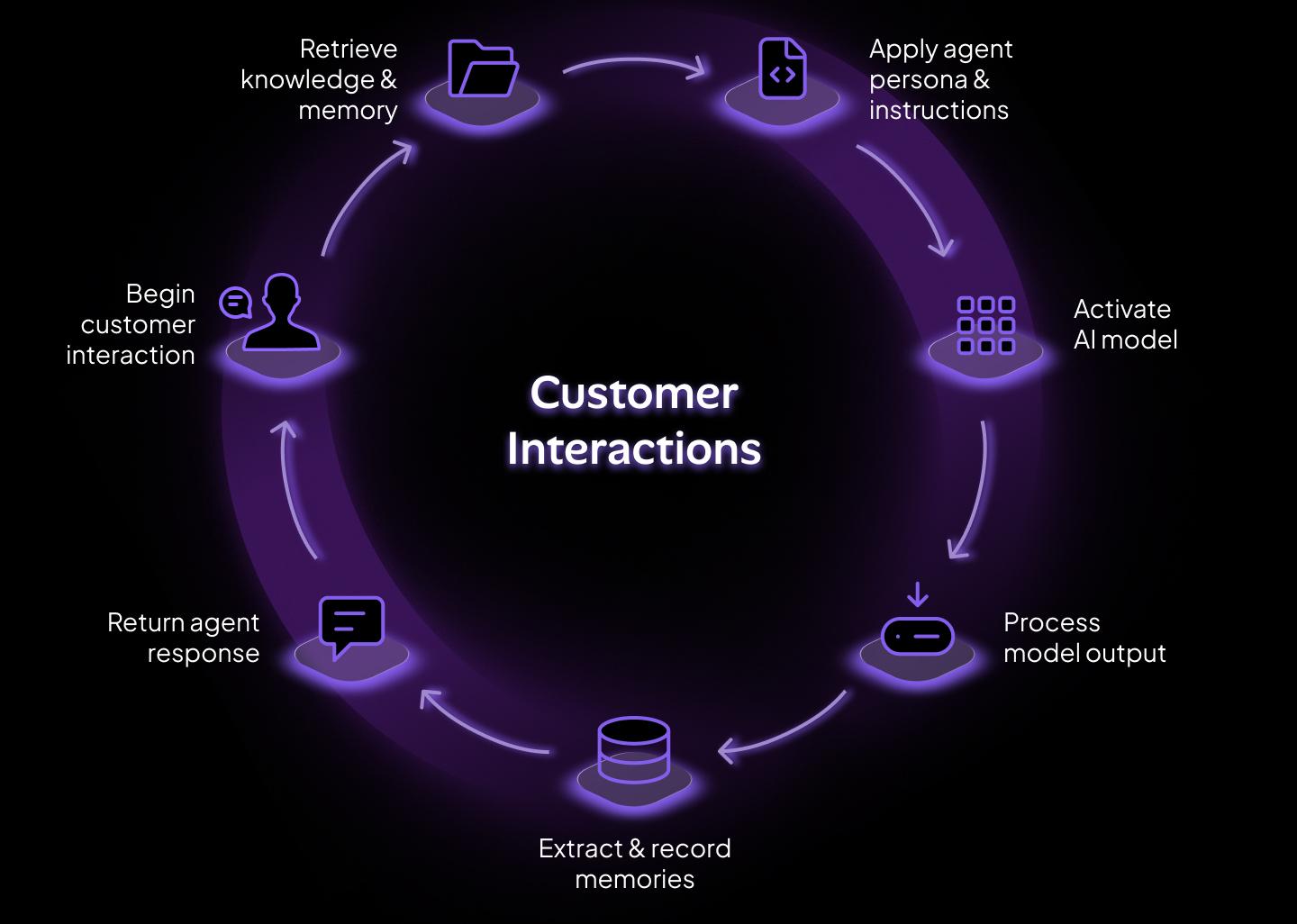
An Actia agent's role specifies its remit, tone, boundaries, and the knowledge it draws on, and is applied at the start of each customer interaction. When an agent is initially created, its name, gender, and voice are chosen to reflect its desired persona. Agents may be selected from a range of pre-trained roles covering typical business functions in sales, service, customer support, and other areas. The selected role is then augmented with custom characteristics and instructions, which can be refined over time to finely tune each agent's behavior.
Knowledge & Memory
Actia agents are grounded in company and customer information, rather than general training data. Information is ingested via vector embedding, so it can be semantically retrieved prior to and during customer interactions. Corporate knowledge, from sources such as the company website, can be loaded and regularly updated. And after every interaction, agents identify and remember any new customer-related facts and information. Memory persists across sessions and channels, allowing an agent to recognize a returning customer and resume an open matter with full context rather than starting cold.
Collaborative Workspace
Actia agents are designed to liaise seamlessly with existing staff. Staff and agents share a common workspace where agents can answer questions, report activity, accept instructions, and request guidance when a situation calls for it. Every interaction is recorded, which gives staff visibility into what agents are doing and a point of intervention. This way an agent behaves less like an external tool and more like a member of the team whose work is observable and directable.
Workflow & Outcomes
Actia agents are designed to follow specified workflows in order to achieve desired outcomes, such as a qualified sales propspect, a completed purchase order, or a resolved customer support case. Workflows define a sequence of targeted steps an agent works through, giving interactions structure rather than leaving them as open-ended conversations. Because an outcome is explicit, an agent can steer a conversation toward it across multiple turns and channels, recognize when it has been reached, and record the result as a tracked outcome the business can measuren and act on.
Agent Autonomy
How much an agent does on its own is an adjustable setting. Underpinning this is a Human-in-the-Loop framework central to ensuring agent reliability and judgement. When an agent encounters a situation that requires human authority, such as a contract approval or a high-value refund, it flags the decision for review by a human supervisor. In this way agents can be configured to handle routine work independently, while final decision-making power on high-stakes actions remains with customer staff. As confidence grows, agent autonomy can be increased and decision-making latitude widened.
For more on the architecture behind them, read about the Actia AI platform.